
Complete guide for Pakistani students — F-1, J-1, M-1, OPT & STEM OPT eligibility, financial proof, fees, processing time, documents, work rights and post-study options.
F-1 (Academic)
Bachelor's / Master's / PhD
Not available
IELTS / TOEFL / PTE
Required
On-campus 20 hrs/week
OPT (12–36 months)
Yes (Spouse & children)
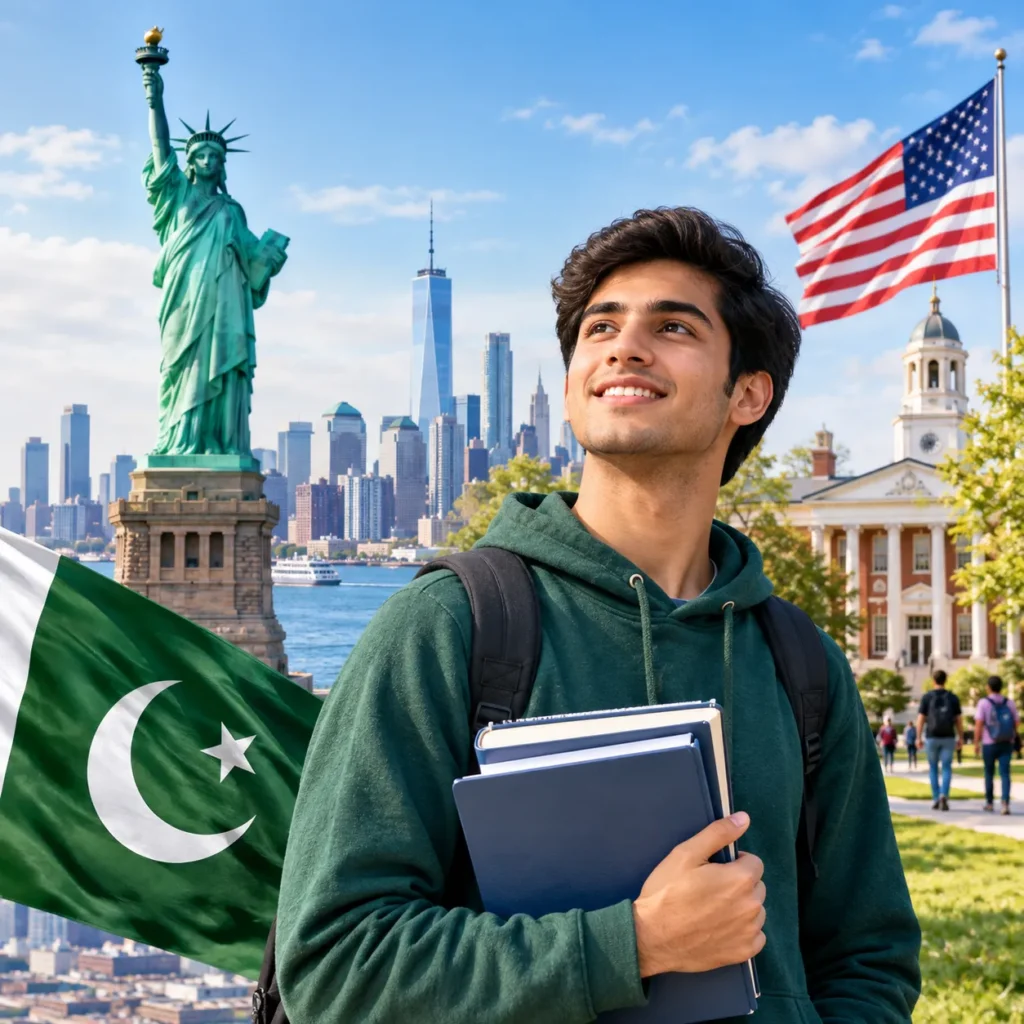
The USA is one of the world’s top study destinations, offering a diverse range of world-class universities, flexible degree programs and strong research opportunities. Pakistani students can choose from over 4,000 accredited institutions, including top-ranked universities, community colleges and specialized schools, across various fields.
The USA offers multiple student visa routes, including the F-1 visa for academic programs and the J-1 visa for exchange programs. It also provides valuable post-study work options like OPT, and opportunities for long-term career growth. This page gives you a complete guide to help you understand the USA student visa process, requirements and opportunities available to Pakistani students.
⚠ Major 2026 Policy Overhaul — the decades-old "Duration of Status" (D/S) framework has been replaced with a fixed admission period: students are now admitted for a maximum of 4 years or their program end date, whichever is shorter, printed on the electronic Form I-94. Programs genuinely running longer (some STEM/PhD tracks) now require a formal Form I-539 Extension of Stay with USCIS and biometrics — no longer just a SEVIS update from the school's DSO. This is the single most important change to understand before choosing a US programme.
Explore the five student visa categories available for Pakistani students in the USA — select one to see full eligibility, fees and documents.
For full-time academic study at U.S. institutions.
For exchange programs and research scholar positions.
For vocational and non-academic training programs.
For work experience after completing your degree.
For spouses and children (depending on visa type).
The primary US student visa for academic study — undergraduate, graduate, or doctoral programmes — at a school certified by the Student and Exchange Visitor Program (SEVP). The F-1 is not a work visa, but it carries built-in work-authorisation mechanisms (CPT and OPT) that make it one of the most valuable student statuses globally.
A visa for participants in State Department-designated exchange visitor programs, commonly used for short-term study, research scholar positions, and certain university exchange arrangements — distinct from the F-1's standard degree-seeking pathway.
A visa for students pursuing vocational or non-academic training programs (technical/trade schools) at an SEVP-certified institution — distinct from the F-1's academic focus.
Optional Practical Training (OPT) allows F-1 students to work in the US in a role directly related to their field of study, both before (pre-completion) and after (post-completion) finishing their degree — with an additional 24-month STEM OPT extension for qualifying STEM graduates, making this one of the more generous post-study work windows among major study destinations.
Visas for the spouse and unmarried children under 21 of F-1, M-1 and J-1 visa holders respectively, allowing dependents to accompany the primary visa holder to the United States.
The replacement of Duration of Status (D/S) with a fixed 4-year maximum admission period (or program end date, whichever is shorter) is the most consequential F-1 change in decades — it directly affects any Pakistani student considering a program that may run longer than 4 years, who must now plan for a formal Form I-539 Extension of Stay application with USCIS rather than relying on their DSO.
USCIS now requires in-person biometrics for OPT and STEM OPT applications filed after mid-December 2025, and the Form I-765 Premium Processing fee is $1,780 with a guaranteed 30-day adjudication — both genuine 2026 changes worth highlighting clearly to clients planning their post-study work timeline.
A possible new $250 "visa integrity fee" has been discussed for introduction in 2026, but official implementation guidance had not been released at the time of this review — monitor for confirmation before treating this as a settled cost.
International students are currently facing heightened scrutiny at US consulates and in status-maintenance matters generally. Clients should be advised to maintain scrupulous SEVIS compliance, check their SEVIS/I-94 status regularly, and consult a qualified immigration attorney for any complex situation — 7 Continents provides guidance and document preparation, not legal representation before USCIS or the State Department.
Degree/certificate equivalency and attestation through the Higher Education Commission (HEC) and Inter Board Committee of Chairmen (IBCC) is required for most US study-visa applications from Pakistan, and a common source of delay when not understood in advance. Confirm the specific documents each target institution requires attested — commonly needed before the Form I-20 is even issued.
HEC Attestation
IBCC Attestation
Degree Equivalency
Relevant scholarship options for Pakistani students pursuing US study include Fulbright and HEC-affiliated scholarships, which can help address the financial-proof barrier that prevents many qualified students from applying. Check current eligibility criteria and application windows well ahead of your intended intake.
Fulbright (USA)
HEC Scholarships
No. As of the 2026 reforms, F-1 admission is now capped at a fixed 4 years or the program end date, whichever is shorter — replacing the previous open-ended Duration of Status framework.
Up to 36 months total — 12 months of standard OPT plus a 24-month STEM OPT extension for qualifying STEM degrees, provided the employer is E-Verify registered.
$535 total — the $350 SEVIS I-901 fee plus the $185 MRV visa application fee, excluding any additional reciprocity fee, medical exams, or English test costs.
Get a free, personalised assessment from our migration experts in Islamabad.