
Explore the Netherlands’ work visa routes available to qualified Pakistani applicants — the Highly Skilled Migrant (Kennismigrant) scheme, EU Blue Card, Intra-Corporate Transferee (ICT) Visa, Orientation Year for Highly Educated Persons, and the Self-Employment / Freelance Residence Permit.
Pakistani applicants guided nationwide
Every file tracked end to end
Guidance you can trust
From assessment to approval
A Permit You Can Enter On Without a Job Offer — the Orientation Year (Zoekjaar) lets recent graduates, doctoral degree holders, and former researchers live in the Netherlands for up to a year on an open work permit while they search for skilled work — often bridging into the Highly Skilled Migrant route at a reduced salary threshold once employment is secured.
Netherlands Work Visa Categories
IND Fee for HSM, Blue Card & ICT (2026)
Typical IND Decision With a Recognized Sponsor
Orientation Year Search Permit, No Employer Needed
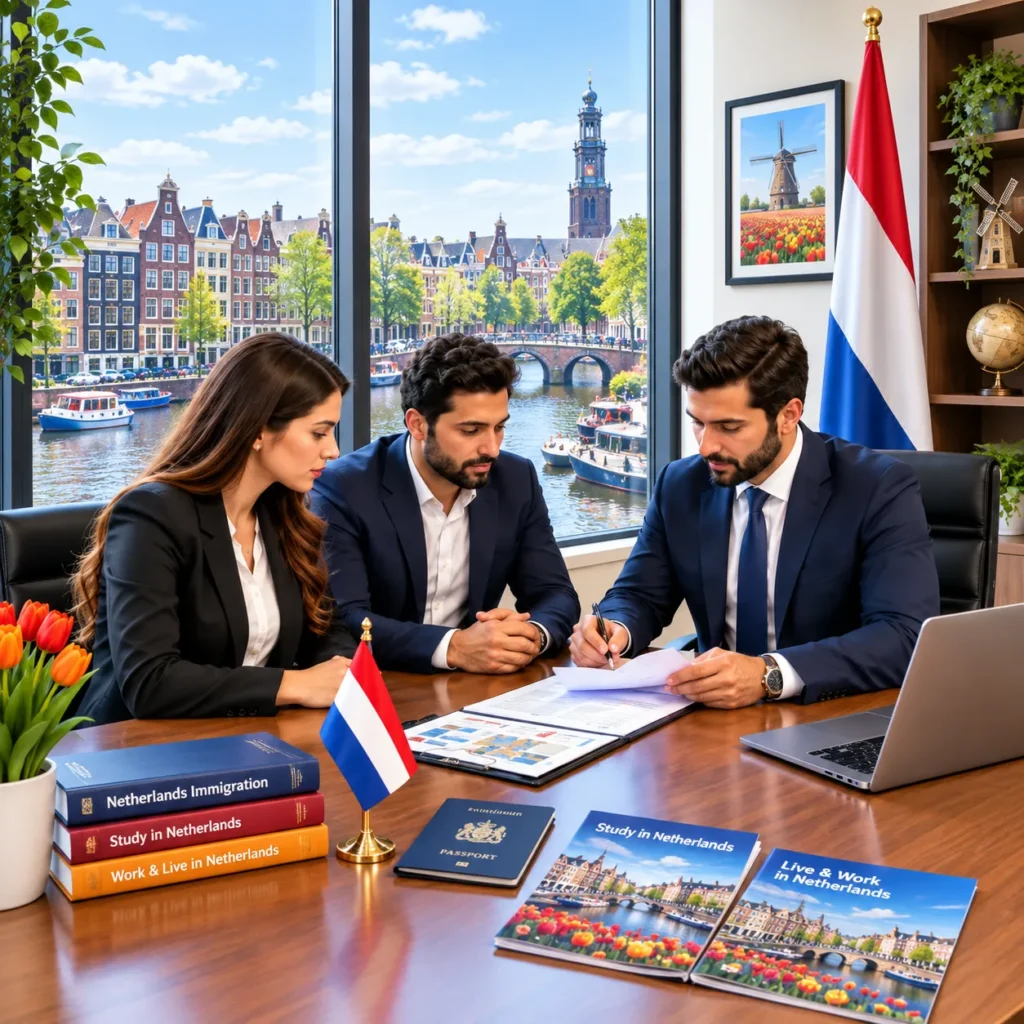
The Netherlands’ primary route for skilled non-EU professionals is the Highly Skilled Migrant (Kennismigrant) scheme, administered by the IND through recognized sponsor employers — one of the fastest work visa routes in Europe, since it skips the labour market test entirely. Alongside it, the EU Blue Card adds EU-wide mobility rights, the Intra-Corporate Transferee permit serves multinational staff moving within the same corporate group, the Orientation Year gives recent graduates and researchers up to a year to search for qualifying work without a sponsor, and the Self-Employment / Freelance permit suits entrepreneurs with a strong, well-documented business plan. IND fees for the most-used categories rose to €423 in 2026, and sponsor-compliance checks have increased alongside them. 7 Continents Migration Experts guides Pakistani applicants through the category that matches their job offer, salary, and career stage.
Visa requirements may change. Always check the latest requirements with the Dutch authorities before applying.
Dutch work permit fees, salary thresholds, tax rules, and sponsorship requirements may change periodically. Employers and applicants should ensure they meet the latest requirements and maintain any required employment and salary records for compliance purposes. Processing times and eligibility criteria can also vary depending on the permit category and individual circumstances. This page covers temporary work permits only; Dutch permanent residence and citizenship pathways are covered separately.
7 Continents Migration Experts offers professional immigration guidance, tailored solutions, and dedicated support to help you move forward with confidence.
Explore the work visa routes available to qualified Pakistani applicants — fast-track, search-year, and standard.
The Netherlands' primary work permit route for skilled non-EU professionals, based on a salary threshold rather than a fixed occupation list. The employer must be an IND-recognized sponsor, which allows for fast, streamlined processing without a labour market test — one of the fastest work visa routes in Europe.
IND application fee (effective 1 January 2026): €423 for first application, change of purpose, or extension. This is the standard annual indexation (4.4% for 2026) and applies uniformly across HSM, EU Blue Card, ICT, and GVVA single permit categories.
With a recognized sponsor, the IND aims to decide within 2 weeks of a complete application — some sources cite 2–4 weeks as the realistic range, making this one of the fastest work visa timelines in Europe. If the employer is not yet a recognized sponsor, add up to 90 days for that recognition step first.
The Netherlands' implementation of the EU-wide Blue Card for highly qualified professionals — offering EU-wide mobility rights that the national Highly Skilled Migrant permit does not provide, though with somewhat stricter qualification requirements.
IND application fee (effective 1 January 2026): €423 — the same fee structure as the Highly Skilled Migrant permit.
Typically 2–8 weeks in practice, with a legal maximum of 90 days under EU law if the IND does not decide sooner.
A search-year residence permit allowing recent graduates, doctoral degree holders, or former researchers to live in the Netherlands for up to 1 year while looking for qualifying skilled work — an open work permit not tied to a specific employer, often used as a bridge to the Highly Skilled Migrant or EU Blue Card route at the reduced salary threshold.
IND application fee: €254 (Orientation Year, researcher, and seasonal labour permits carry this lower fee compared to the €423 charged for HSM/Blue Card/ICT).
Standard IND processing timelines apply, generally faster than sponsor-dependent categories since no employer sponsorship verification is required — confirm the current specific timeline via the IND before advising an exact figure.
A permit allowing multinational companies to transfer managers, specialists, or trainees from a non-EU branch — such as a Pakistani office — to a related Dutch entity, implementing the EU ICT Directive. Exempt from the standalone work-permit (TWV) requirement and the labour market test.
IND application fee (effective 1 January 2026): €423 — same fee structure as the Highly Skilled Migrant and EU Blue Card permits.
Typically 2–8 weeks, similar to the EU Blue Card timeline.
A residence permit for non-EU nationals wishing to work as a self-employed professional or freelancer in the Netherlands, assessed on a points-based system evaluating the business plan, personal experience, and added value to the Dutch economy.
IND application fee (effective 1 January 2026): €423, per the standard fee tier that also covers self-employed permit applications.
Standard IND processing timelines apply, though business plan assessment may extend the review compared to salary-based categories — confirm the current specific timeline via the IND before advising an exact figure.
Get a Personalized Visa Assessment From Our Netherlands Immigration Experts and Discover the Best Visa Option for Your Profile.
This page covers temporary, renewable work permits only — the Highly Skilled Migrant scheme, EU Blue Card, ICT, Orientation Year, and Self-Employment permit. Time spent legally resident in the Netherlands on most of these routes builds toward Dutch permanent residence, but the exact rules, waiting periods, and integration requirements differ by category and are covered in detail in our separate Netherlands Immigration & Permanent Residence guide. The EU Blue Card and ICT permit carry their own distinct implications for future EU-wide mobility, worth weighing carefully for clients whose long-term goal is settlement in the Netherlands specifically rather than mobility across the EU.IND fees for the most-used work permits (Highly Skilled Migrant, EU Blue Card, ICT, GVVA single permit) rose to €423 effective 1 January 2026, a 4.4% annual indexation tied to Dutch collective labour agreement (CAO) wage growth. Orientation Year, researcher, and seasonal labour permits carry a lower €254 fee. These figures should be re-verified against the official IND fees page before publishing, as they are indexed annually. The Dutch 30% tax ruling is scheduled to reduce from 30% to 27% from 1 January 2027 for all participants, including those whose ruling started in 2024 or later — the transitional arrangement that previously shielded some existing recipients from the €262,000 salary cap also expired on 1 January 2026, meaning the cap now applies universally. This is a meaningful financial planning point worth flagging to prospective clients considering the Netherlands. From 1 January 2026, IND-recognized sponsors must retain salary payment records for Kennismigrant employees for audit purposes, and IND inspection visits to sponsors have increased in 2026 — while this doesn't change anything for employees directly, it underscores the importance of choosing a genuinely compliant, well-established sponsoring employer.
Yes. Pakistani nationals are eligible for the Netherlands' main work visa categories, including the Highly Skilled Migrant scheme and EU Blue Card, with no nationality-based restrictions on these routes.
The IND application fee is €423 for Highly Skilled Migrant, EU Blue Card, and ICT permits, or €254 for the Orientation Year permit, effective 1 January 2026.
Not always. The Orientation Year (Zoekjaar) permit allows recent graduates and researchers to search for qualifying work for up to 1 year without a prior job offer, on an open permit not tied to any employer.
For 2026, the minimum gross monthly salary is €5,942 for applicants aged 30 and over, and €4,357 for applicants under 30. A reduced threshold of €3,122/month applies to recent graduates applying within 3 years of graduation.
Both skip the labour market test, but the Highly Skilled Migrant route is generally faster and tied only to the Netherlands, while the EU Blue Card requires a longer 12-month contract and a Nuffic-evaluated degree in exchange for EU-wide mobility rights.
Up to 3 years for managers and specialists, or 1 year for trainees, with no renewal beyond this cap. Clients planning a longer stay are generally advised to transition to the Highly Skilled Migrant route before the cap is reached.
Yes. The 30% tax-free allowance is scheduled to reduce to 27% from 1 January 2027 for all participants, and a previously protective transitional salary-cap exemption expired on 1 January 2026 — worth factoring into financial planning for prospective applicants.
Your Netherlands Work Visa journey starts with choosing the right category. Let our team assess your profile, explain your options, and guide you through the application process.