
Complete guide for Pakistani students — Type D Visa & Residence Permit (Migration Directorate), Post-Study Options and Family Reunification, including fees, processing time, financial proof and documents. Content last verified July 2026.
Type D long-stay visa (6–12 months, multiple-entry) at a Bulgarian embassy/consulate, then a residence permit from the Migration Directorate after arrival
Acceptance letter from a recognised Bulgarian institution (full-time only); clean criminal record; no nationality-based restriction
Sources vary: half a year’s tuition, €5,000–6,000/year, or ~6,240 BGN (~€3,000) — confirm via consulate
Type D visa up to 35 working days per one source; no consistent figure — apply well in advance
Typically 1–3 months (up to ~12 weeks); reduced capacity in summer; appeals add ~4 months
Up to 20 hrs/week during the academic year; full-time in official holidays; no separate work permit
UNRESOLVED — sources conflict on whether graduates can stay at all; verify with the Migration Directorate
Spouse/cohabitant & children — must apply separately, AFTER the student's permit is grantedNot detailed for student sponsors — confirm eligibility, fee and documents with the Migration Directorate
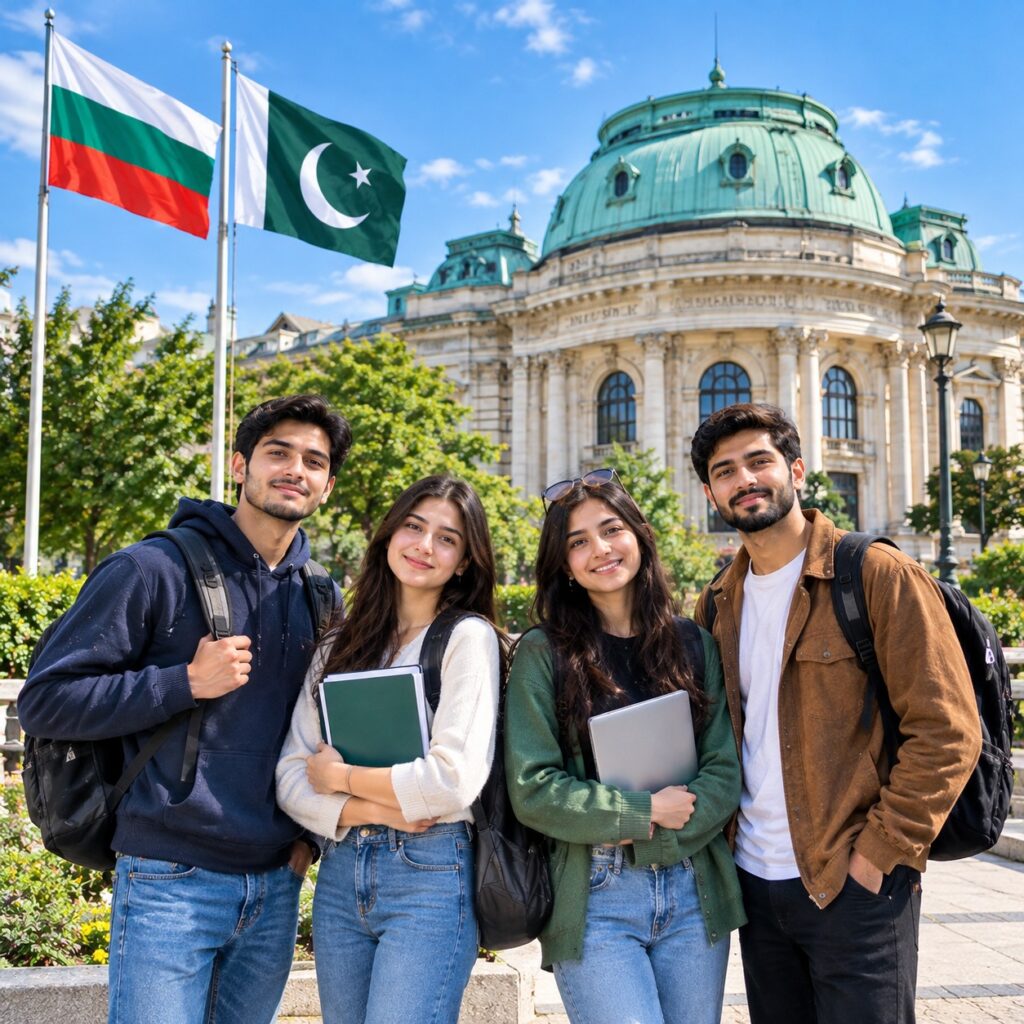
Bulgaria offers comparatively low tuition (particularly for Medicine and Engineering, taught in English) and living costs among the lowest in the EU. 7 Continents Migration Experts guides Pakistani applicants through the category that matches their circumstances, though the genuine post-study uncertainty below should be discussed candidly with any client considering Bulgaria specifically for its post-study prospects.
This page covers three core categories: Type D Visa & Residence Permit for Study (Main Study Visa), Post-Study Options, and Family Reunification. Each includes General Eligibility (any nationality) and Eligibility for Pakistani Nationals, plus HEC/IBCC attestation and scholarship guidance.
🔴 MOST SEVERE, DIRECTLY CONTRADICTORY CONFLICT: sources reviewed give fundamentally opposite answers to whether a graduate can remain in Bulgaria at all after finishing studies. One source states explicitly: “At the end of the student visa period the student must leave Bulgaria and he/she is NOT PERMITTED to switch to any other visa route.” Another describes graduates being able to switch to another permit type (e.g. a work permit if they find a job) or potentially a job-search permit IF Bulgaria implements the EU rule allowing graduates 9 months to seek work. A third implies a comparatively smooth path to Permanent Residence. Do not publish any definitive post-study statement without confirming the current legal position with the Bulgarian Migration Directorate first.
⚠ FEE VARIANCE: the Type D visa fee is cited as €100 by several sources, but at least one source states 100 BGN (approximately €51) — roughly half. Confirm whether the fee is denominated in euros or Bulgarian lev via the specific consulate before quoting a figure to a client.
✓ IMPORTANT RULE: family members cannot apply at the same time as the principal student — UDI does not have the capacity to process both together. The family application must be submitted separately, after the student's own permit has been granted.
Explore the three categories covered for Pakistani students applying to Bulgaria — select one to see full eligibility, fees and documents.
Bulgaria’s two-stage route: Type D long-stay visa before travel, then a residence permit after arrival.
Student-sponsor rules, fees and documents must be confirmed directly with the Migration Directorate.
Spouse/cohabitant and children can apply — separately, after the student's own permit is granted.
Bulgaria’s two-stage process for non-EU/EEA students: a Type D national long-stay visa (multiple-entry, valid 6–12 months) obtained at a Bulgarian embassy/consulate before travel, followed by a residence permit from the Migration Directorate after arrival, which authorises the actual duration of stay for study.
GENUINELY UNRESOLVED — sources reviewed for this document give fundamentally conflicting answers to whether any post-study option exists in Bulgaria at all. This section should not be relied upon for client-facing advice until independently confirmed with the Bulgarian Migration Directorate.
General family reunification provisions exist in Bulgaria’s broader immigration system, though specific rules, financial thresholds, and required documents for a STUDENT sponsor specifically were not detailed with precision in the sources reviewed for this document.
🔴 POST-STUDY CONFLICT: the severe, directly contradictory conflict on post-study options is by far the most important open question on this page — it must be resolved directly with the Bulgarian Migration Directorate before any client-facing statement is made about staying in Bulgaria after graduation.
FEE DISCREPANCY: the Type D visa fee discrepancy (€100 vs 100 BGN, roughly a 2x difference) should be resolved directly with the specific consulate before quoting a figure to any client.
CLIENT GUIDANCE: clients drawn to Bulgaria primarily for its low cost should be clearly told that a smooth post-graduation transition is NOT currently confirmed, and Bulgaria should not be positioned as a reliable long-term EU settlement pathway until this is independently verified.
Academic transcripts and degree certificates should be HEC/IBCC attested with certified/notarised Bulgarian translation, presented in person at the embassy/consulate. Confirm current document requirements.
HEC Attestation
IBCC Attestation
Notarised Bulgarian Translation
Relevant scholarship options for Pakistani students include Bulgarian government-affiliated scholarships (via the Ministry of Education and Science) and university-specific tuition support.
Bulgarian Govt-Affiliated
University Tuition Support
Fulbright
HEC Scholarships
This is genuinely unclear from available sources — one source says graduates must leave and cannot switch visa types, another says a switch to a work permit is often possible. Confirm directly with the Migration Directorate before making any plans around this.
Sources conflict — cited as either €100 or 100 BGN (roughly €51). Confirm the exact current fee and currency with the specific consulate.
Up to 20 hours/week during term, full-time during holidays — no separate work permit needed.
Get a free, personalised assessment from our migration experts in Islamabad.