
Explore Croatia’s Work Permit Routes Available To Qualified Pakistani Applicants — the standard Stay and Work Permit, the EU Blue Card2026 UPDATE, the Intra-Corporate Transfer (ICT) Route, and the Seasonal Work Permit. Croatia abolished its work permit quota system on 1 January 2021, and broad-ranging 2025-2026 reforms have since made the system more flexible, with the Ministry of the Interior (MUP) administering applications alongside the Croatian Employment Service (HZZ).
Pakistani applicants guided nationwide
Every file tracked end to end
Guidance you can trust
From assessment to approval
Croatia Work Permit Categories
Anticipated 2026 Job Openings
EU Blue Card Salary Threshold (indexed)
Standard EU Blue Card Processing
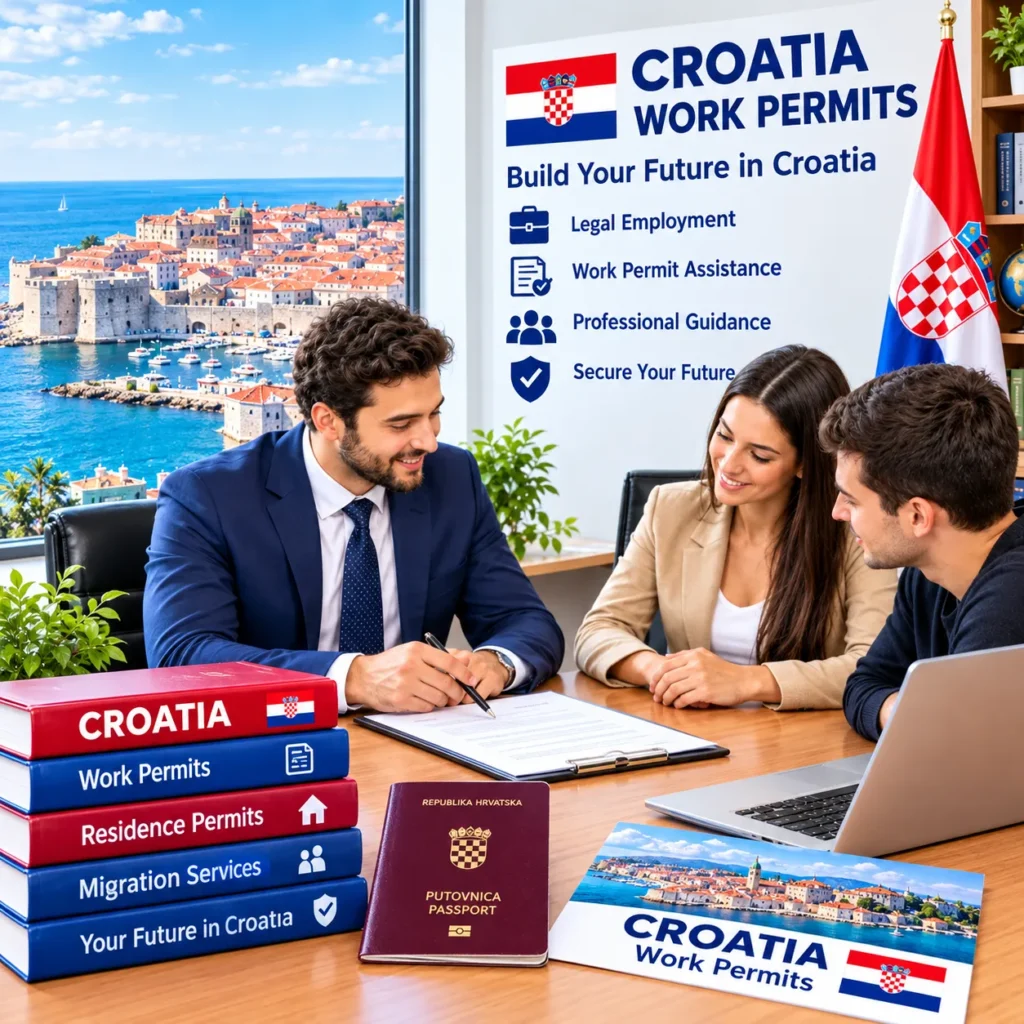
Croatia abolished its work permit quota system on 1 January 2021, creating a more accessible route for non-EU nationals via the standard Stay and Work Permit, alongside the EU Blue Card for highly qualified professionals. Croatia has since implemented broad-ranging 2025-2026 reforms — extending permit validity periods, easing EU Blue Card eligibility, relaxing change-of-employer rules, and allowing work permit holders to take on limited secondary employment. With around 70,000 job openings anticipated in 2026 and 3% annual economic growth, Croatia faces genuine labour shortages, particularly in IT, engineering, healthcare, and tourism. 7 Continents Migration Experts guides Pakistani applicants through the category that matches their job offer.
Visa and immigration requirements may change. Always check the latest requirements with the Croatian authorities before applying.
Croatia’s work-permit rules allow certain foreign workers to take on limited additional employment, subject to applicable conditions. Employer obligations and enforcement requirements also apply under Croatian employment and immigration law. This page covers temporary and renewable work permits only. Croatian permanent residence and citizenship pathways are covered separately.
7 Continents Migration Experts offers professional immigration guidance, tailored solutions, and dedicated support to help you move forward with confidence.
Explore the work permit routes available to qualified Pakistani applicants.
Croatia's standard combined residence-and-work permit for non-EU nationals with a Croatian job offer, covering most employment outside the highly-qualified EU Blue Card route. The quota system for this category was abolished on 1 January 2021, making it more broadly accessible than under the previous framework.
Approximately €115-€120 total is a reasonable current estimate based on Croatia's Blue Card-equivalent fee structure (following the January 2023 euro changeover from the Croatian kuna) — confirm the exact current Stay and Work Permit fee via the Croatian Ministry of the Interior (MUP) or Embassy Islamabad, as the precise current figure was not itemized with full certainty in the sources reviewed.
Typically 1-3 months (8-12 weeks per some 2026 sources) after all required documents are submitted and any labour market test is completed. Once fees are paid and the application approved, the physical residence permit can generally be collected at the designated police station approximately 21 days later. Short-term business/work visas process faster, typically 2-4 weeks.
Croatia's route for highly qualified non-EU professionals — a combined stay-and-work permit offering EU-wide mobility benefits, no labour market test, and generally faster, more predictable processing than the standard Stay and Work Permit route.
Administrative fee for the stay-and-work permit decision: €74.32. Biometric residence card: €31.85 (normal procedure) or €59.73 (accelerated procedure), plus an additional €9.29 fee for the biometric card (both procedures). Total: approximately €115.46 (normal) or €143.34 (accelerated). The same fee structure applies for renewal and replacement.
National law sets a maximum EU Blue Card processing time of 30-60 days — one of the more predictable EU Blue Card timelines, and generally faster than the standard Stay and Work Permit given the absence of a labour market test.
A pathway allowing employees of multinational companies to transfer from a non-EU branch (such as a Pakistani office) to a related Croatian entity, with Croatia's 2025 reforms specifically easing qualification rules for ICT specialists by recognizing high-level professional skills through experience rather than requiring formal education.
Comparable to the EU Blue Card fee structure (approximately €115-€143 depending on procedure) if processed via that route, given the experience-based ICT recognition pathway — confirm exact current figure via the Croatian Ministry of the Interior before publishing.
Generally comparable to the EU Blue Card timeline (30-60 days) when processed via that route, given the shared quota-free, no-labour-market-test status.
A visa for temporary employment in sectors with seasonal labour demand — primarily tourism and agriculture — allowing single-entry, employer-led work for up to 90 days, but not leading to long-term settlement.
Confirm exact current seasonal-permit fee via the Croatian Ministry of the Interior or Embassy Islamabad — not itemized with precision in the sources reviewed for this document.
Generally faster than standard employment-based permits given the short-term, defined nature of the role — confirm current specific timeline via the Croatian Embassy Islamabad.
No — the standard route combines residence and work authorization into a single Stay and Work Permit, administered by the Ministry of the Interior (MUP) in coordination with the Croatian Employment Service (HZZ). Both the Stay and Work Permit and the EU Blue Card are now issued as biometric documents, and there is no second document to apply for separately.
Stay and Work Permit and EU Blue Card holders may become eligible for Croatian permanent residence after 5 years of continuous, lawful residence in Croatia, provided the qualifying-period residence rules are met throughout. Time spent on a Seasonal Work Permit does not count toward this 5-year requirement, since that route is single-entry and capped at 90 days per season.Croatia has implemented broad-ranging 2025-2026 immigration reforms: extended validity periods for several work permit types, eased EU Blue Card eligibility (including experience-based recognition for certain ICT roles), relaxed change-of-employer rules, and — notably — work permit holders can now work up to 8 hours/week with a second employer, a flexibility not previously available. From 1 January 2026, new provisions on auditing and enforcement of employer obligations came into force, covering serious violations of employment laws and breaches of social security/occupational safety requirements — this increases compliance expectations on Croatian sponsoring employers and is worth mentioning when vetting employer credibility with clients. Croatia's EU Blue Card salary threshold (confirmed 2023 figure: €24,845.64/year) is indexed annually by the Croatian Bureau of Statistics — some 2026 estimates suggest a figure closer to €2,300/month, but this should be confirmed against official 2026 published data before publishing an exact number. Please note — Croatia issues a combined Stay and Work Permit rather than a separate standalone work permit document, and both this permit and the EU Blue Card are now issued as biometric documents.
Yes. Pakistani nationals are eligible for Croatia's main work visa categories, including the Stay and Work Permit and EU Blue Card, with no nationality-based restrictions on these routes.
No. Croatia abolished its work permit quota system on 1 January 2021, making the standard Stay and Work Permit more broadly accessible for non-EU nationals.
The confirmed 2023 figure is €24,845.64/year (€2,070.47/month) — 1.5x Croatia's average gross salary. This threshold is indexed annually, with some 2026 estimates suggesting approximately €2,300/month; the exact current figure should be verified via the Ministry of the Interior before applying.
National law sets a maximum of 30-60 days for a complete application — generally faster and more predictable than the standard Stay and Work Permit route, since the EU Blue Card does not require a labour market test.
Yes, since a 2025 reform. Stay and Work Permit holders can now work with a second, different employer for up to 8 hours per week — a flexibility that was not previously available under Croatian immigration law.
Employees of multinational companies being transferred from a non-EU branch — including a Pakistani office — to a related Croatian entity. Since 2025, certain ICT specialist roles can qualify through professional experience rather than a formal university degree.
No. The Seasonal Work Permit is a single-entry, employer-led route capped at 90 days with no automatic renewal, and time spent on it does not count toward Croatia's 5-year permanent residence requirement — unlike the Stay and Work Permit or EU Blue Card.
Your Croatia Work Visa journey starts with choosing the right permit category. Let our team assess your profile, explain your options, and guide you through the application process.