
Complete guide for Pakistani students — Study Permit (Studietillatelse), the Post-Study Job Seeker Permit and Family Reunification, including fees, processing time, financial proof and documents. Content last verified July 2026.
Study Permit / Studietillatelse (issued by UDI — Norwegian Directorate of Immigration); Type D entry visa issued automatically
Full-time programme at a NOKUT-accredited institution; stays over 90 days
NOK 126,357–166,859/year across sources (NOK 166,859 most cited) — confirm via UDI
NOK 4,900 first-time / 5,400 renewal vs NOK 6,300 (sources conflict) — confirm via UDI
Typically 1–3 months (up to ~12 weeks); reduced capacity in summer; appeals add ~4 months
Up to 20 hrs/week in term time; full-time in holidays — contingent on academic progress
Job Seeker Permit for 12 months — cannot be extended
Spouse/cohabitant & children — must apply separately, AFTER the student's permit is granted
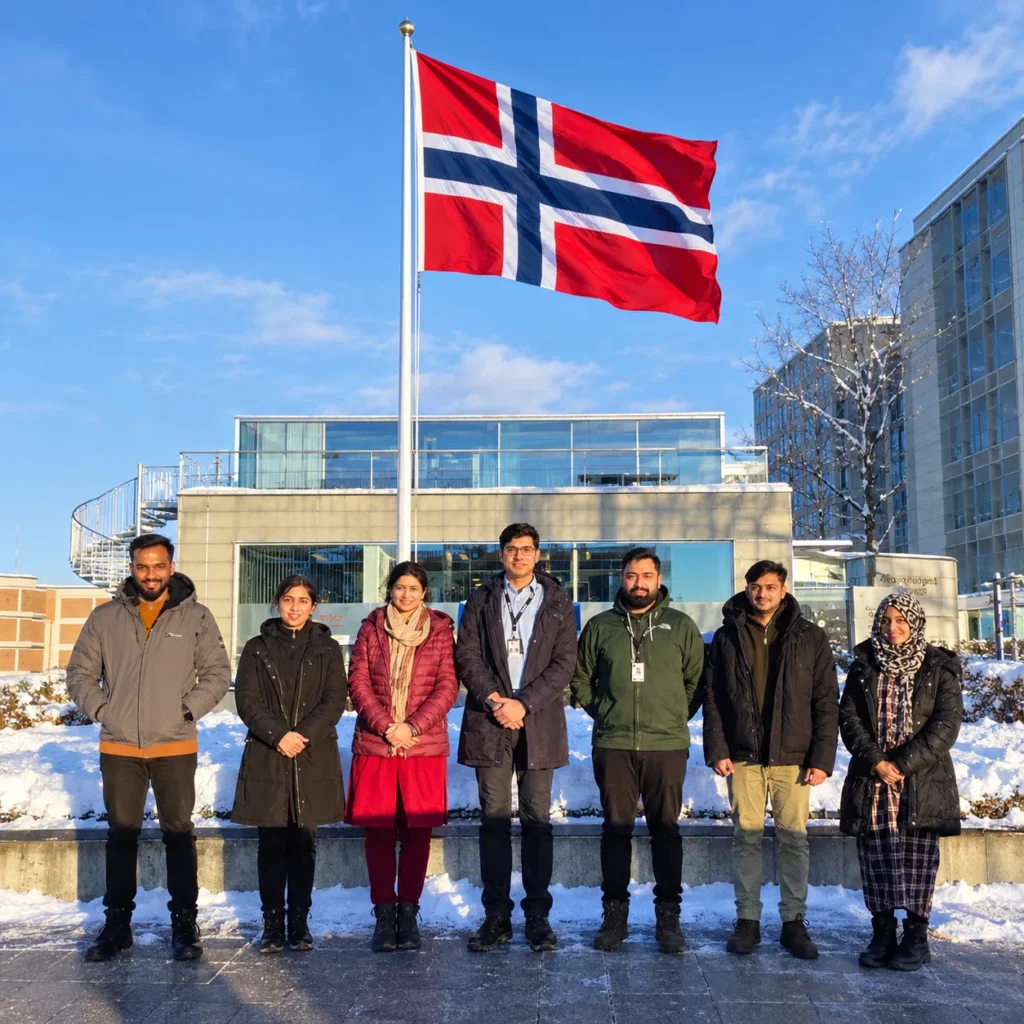
Norway combines strong global rankings in maritime, energy, and technology fields with genuinely flexible average-based work hours during study. 7 Continents Migration Experts guides Pakistani applicants through the category that matches their circumstances.
This page covers three core categories: Study Permit / Studietillatelse (Main Study Visa), Post-Study Job Seeker Permit, and Family Reunification. Each includes General Eligibility (any nationality) and Eligibility for Pakistani Nationals, plus HEC/IBCC attestation and scholarship guidance.
🔴 MAJOR, DIRECTLY CONTRADICTORY CONFLICT ON TUITION POLICY: sources reviewed make opposite claims about whether Norway currently charges tuition to international students. One source explicitly states 'the era of free tuition for all in Norway has officially concluded,' describing a 2026 shift toward tuition fees for non-EU students. Another states 'Norway will no longer require international students to pay tuition fees.' These are not simply different figures — they describe opposite policy directions. DO NOT publish either claim as settled fact. Confirm Norway's actual current tuition policy for non-EU/EEA students directly via studyinnorway.no or the specific institution before advising any client, as this fundamentally affects the entire cost picture.
⚠ FINANCIAL THRESHOLD VARIANCE: NOK 126,357, NOK 139,347 (likely a 2025 figure), NOK 151,690, and NOK 166,859 are all cited for the annual living-cost requirement. NOK 166,859 appears most frequently across the more recent, detailed sources reviewed, but confirm the exact current figure via UDI before publishing a single number.
✓ IMPORTANT RULE: family members cannot apply at the same time as the principal student — UDI does not have the capacity to process both together. The family application must be submitted separately, after the student's own permit has been granted.
Explore the three categories covered for Pakistani students applying to Norway — select one to see full eligibility, fees and documents.
Norway's core permit for non-EEA/EFTA students on full-time programmes at NOKUT-accredited institutions.
A non-extendable 12-month permit for graduates to find degree-related full-time work.
Spouse/cohabitant and children can apply — separately, after the student's own permit is granted.
Norway's core authorisation for non-EEA/EFTA nationals studying more than 90 days — processed by UDI (the Norwegian Directorate of Immigration), with a Type D entry visa issued automatically once the underlying study permit is approved (no separate visa application needed).
Norway's post-study residence permit, consistently confirmed at 12 months across sources, allowing graduates to remain in Norway to secure full-time employment related to their degree before transitioning to a Skilled Worker permit.
A pathway for a student's spouse/cohabitant and children to join them in Norway — a firm, well-corroborated rule requires this to be a SEPARATE application process, submitted only after the principal student's own permit has already been granted.
🔴 OPEN QUESTION: The directly contradictory tuition-policy claims flagged at the top of this page are the single most important open question — this is not a minor figure discrepancy but two sources describing opposite policy directions, and must be resolved via studyinnorway.no before any confident statement about Norway's cost of study is published.
PLANNING POINT: The firm, well-corroborated rule that family members CANNOT apply simultaneously with the principal student (UDI explicitly lacks capacity to process both together) is an important practical planning point — clients should be told this clearly upfront so they sequence their family's application correctly rather than assuming a combined process.
⚠ WORK-HOURS LINK: The academic-progress link to work hours (falling behind coursework can trigger a UDI-mandated REDUCTION in permitted working hours, not just academic consequences) is a genuinely distinctive Norway-specific detail worth flagging clearly to clients balancing study and part-time work.
Academic transcripts and degree certificates should be HEC/IBCC attested, with certified translations into English or Norwegian for documents not already in these languages.
HEC Attestation
IBCC Attestation
Certified Translation
Relevant scholarship options for Pakistani students include Finnish government-affiliated scholarships and university-specific tuition waivers.
Lånekassen-affiliated
Institution-Specific Awards
Fulbright
HEC Scholarships
This is genuinely unclear from available sources at the time of writing — confirm the current policy directly via studyinnorway.no or the specific institution, as sources make directly conflicting claims.
No. UDI explicitly requires family members to apply separately, after the principal student's own permit has already been granted.
Yes, for up to 12 months via the Post-Study Job Seeker Permit — this cannot be extended.
Get a free, personalised assessment from our migration experts in Islamabad.