
Complete guide for Pakistani students — Student Route (Main Study Visa), Graduate Route (Post-Study Work), Short-Term Study Visa & Student Dependant Visa eligibility, points system, financial proof, fees, processing time and documents. Content last verified July 2026.

Student Route (Points-Based System)
Age 16+, courses at a licensed UK Student Sponsor
CAS + 70-point system (50 + 10 + 10)
CEFR B2 (degree-level), B1 (some below-degree)
£1,529/month London · £1,171/month outside
£558 (from 8 April 2026)
Graduate Route (2 yrs, reducing to 18 mo. from Jan 2027)
PhD/research & govt-sponsored scholars only
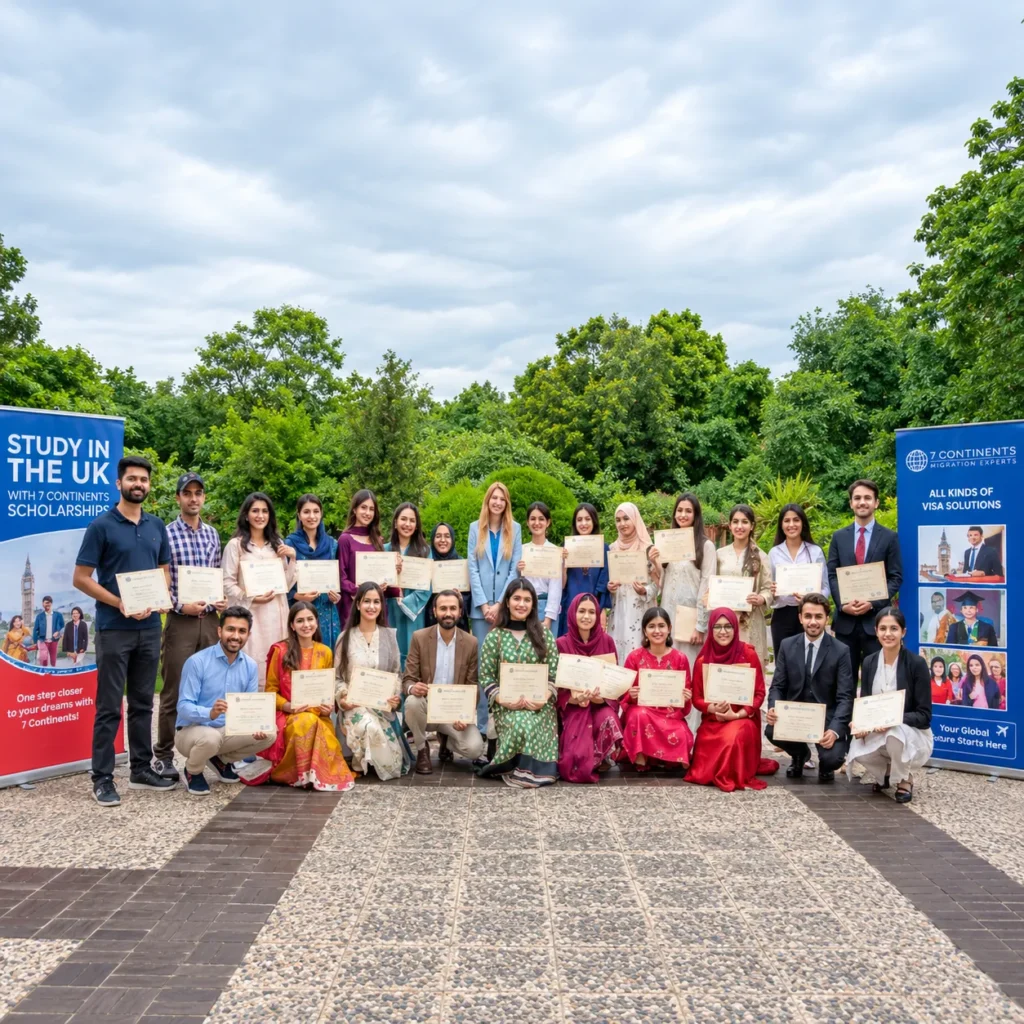
The United Kingdom remains one of the most popular study destinations for Pakistani students, combining world-renowned universities with the Graduate Route — a genuinely valuable, sponsor-free post-study work visa. The Student visa operates under the UK’s points-based system (70 points: 50 for a valid CAS, 10 for financial evidence, 10 for English language), and since January 2024 dependants are restricted to PhD/research students and government-sponsored scholars only.
7 Continents Migration Experts guides Pakistani applicants through the category that matches their programme and circumstances — Student Route (Main Study Visa), Graduate Route (Post-Study Work), Short-Term Study Visa, or Student Dependant Visa.
the Student visa application fee rose to £558 from 8 April 2026. Maintenance fund requirements rose to £1,529/month (London) and £1,171/month (outside London) from 11 November 2025. Most significantly, the Graduate Route will shorten from 2 years to 18 months for bachelor's/master's graduates who apply on or after 1 January 2027 — students due to graduate in 2026 who want the full 2-year Graduate Route should apply on or before 31 December 2026.
Explore the four categories covered for Pakistani students applying to the UK — select one to see full eligibility, fees and documents.
The UK's primary study visa for international students at a licensed Student Sponsor.
Sponsor-free post-study work rights for eligible graduates.
A distinct, separate route for genuinely short courses of 6–11 months.
For partners and children of certain Student Route holders.
The UK's primary study visa, for international students aged 16 or over accepted onto a course at a licensed UK Student Sponsor. Assessed under a 70-point system, it determines not just permission to study but also work rights and whether family members can accompany the applicant.
The UK's post-study work visa, allowing eligible graduates to remain and work in the UK — in any job, at any skill level, without needing employer sponsorship. A genuinely valuable, low-friction bridge to the Skilled Worker visa and longer-term UK residence.
A distinct, separate visa route for genuinely short courses — NOT the same as the Student Route, with its own eligibility, lower fees, and no pathway to settlement or the Graduate Route. A common point of confusion worth clarifying explicitly for prospective clients.
A visa for the partner and children of certain Student Route visa holders — significantly restricted since January 2024, when the UK government removed dependant eligibility for the large majority of taught-course students.
The permanent discontinuation of the Student Direct Stream (8 November 2024) is the most consequential recent change for Pakistani applicants specifically — it removed the distinct fast-track route many previously relied on, and realistic processing under the Regular Study Permit Stream is now 8–12 weeks for all applicants regardless of nationality.
The scheduled reduction of the Graduate Route from 2 years to 18 months (for applications from 1 January 2027) is the single most important planning point for current UK students — clients graduating in 2026 should be clearly and proactively advised to apply for the Graduate Route on or before 31 December 2026 to secure the full 2-year period.
The January 2024 dependant restriction remains one of the most consequential and least understood 2026 rules — undergraduate and taught Master's students genuinely cannot bring a partner or child under the Student Route, full stop. This should be raised proactively with any Pakistani client discussing family plans, well before they commit to a specific programme level.
A possible new $250 'visa integrity fee' has been discussed for introduction in 2026, but official implementation guidance had not been released at the time of this review — monitor for confirmation before treating this as a settled cost.
The Immigration Health Surcharge and Graduate Route fee figures both show genuine variance across sources reviewed (IHS: £776 vs £1,035/year; Graduate Route fee: £822, £880, and £937) — confirm current exact figures directly on GOV.UK before publishing, as these have been actively revised through 2026 and an outdated figure could cause a client to under-budget for their application.
Degree/certificate equivalency and attestation through the Higher Education Commission (HEC) and Inter Board Committee of Chairmen (IBCC) is commonly required during the UK institution's admission process itself, and a common source of delay when not understood in advance. Confirm the specific documents each target institution requires attested.
HEC Attestation
IBCC Attestation
Degree Equivalency
Relevant scholarship options for Pakistani students pursuing UK study include HEC-affiliated scholarships, Chevening, and Commonwealth Scholarships, which can help address the financial-proof barrier that prevents many qualified students from applying. Check current eligibility criteria and application windows well ahead of your intended intake.
HEC Scholarships
Chevening
Commonwealth Scholarships
No. The Student Direct Stream was permanently discontinued on 8 November 2024. All applicants, including Pakistani nationals, now apply through the single Regular Study Permit Stream, with realistic processing of 8–12 weeks.
Currently 2 years for bachelor's/master's graduates applying on or before 31 December 2026 (3 years for PhD graduates) — reducing to 18 months for bachelor's/master's applications made on or after 1 January 2027.
Only if they are a PhD/research student (course of 9+ months) or a government-sponsored scholarship holder. Since January 2024, undergraduate and taught Master's students cannot bring dependants under the Student Route.
Get a free, personalised assessment from our migration experts in Islamabad.