
Complete guide for Pakistani students — Type D Visa & Temporary Residence Permit (OCMA), the Post-Study Stay-Back Permit and Family Reunification, including fees, processing time, financial proof and documents. Content last verified July 2026.

Temporary Residence Permit (TRP) decided by OCMA first, then the Type D visa — the reverse of most countries
Official university invitation filed with OCMA; AIC confirmation of academic documents; no nationality-based restriction
€6,000/year to €10,000/year (~INR 8 lakh) — sources vary; confirm via OCMA
OCMA state fee €160 / €280 / €560 by speed; possible €100 consular fee — confirm for Pakistan mission
Visa stage 15–30 days (up to 45 peak); OCMA TRP review 30–90 days; apply 2–3 months ahead
Up to 20 hrs/week during the academic year; full-time in official holidays
Stay-Back Permit (6-month duration cited by one source) → employment-based TRP → Permanent Residency after 5 years
Notably broad: spouse, children, parents AND siblings of a TRP holder; €740/month per adult, €210/month per minor
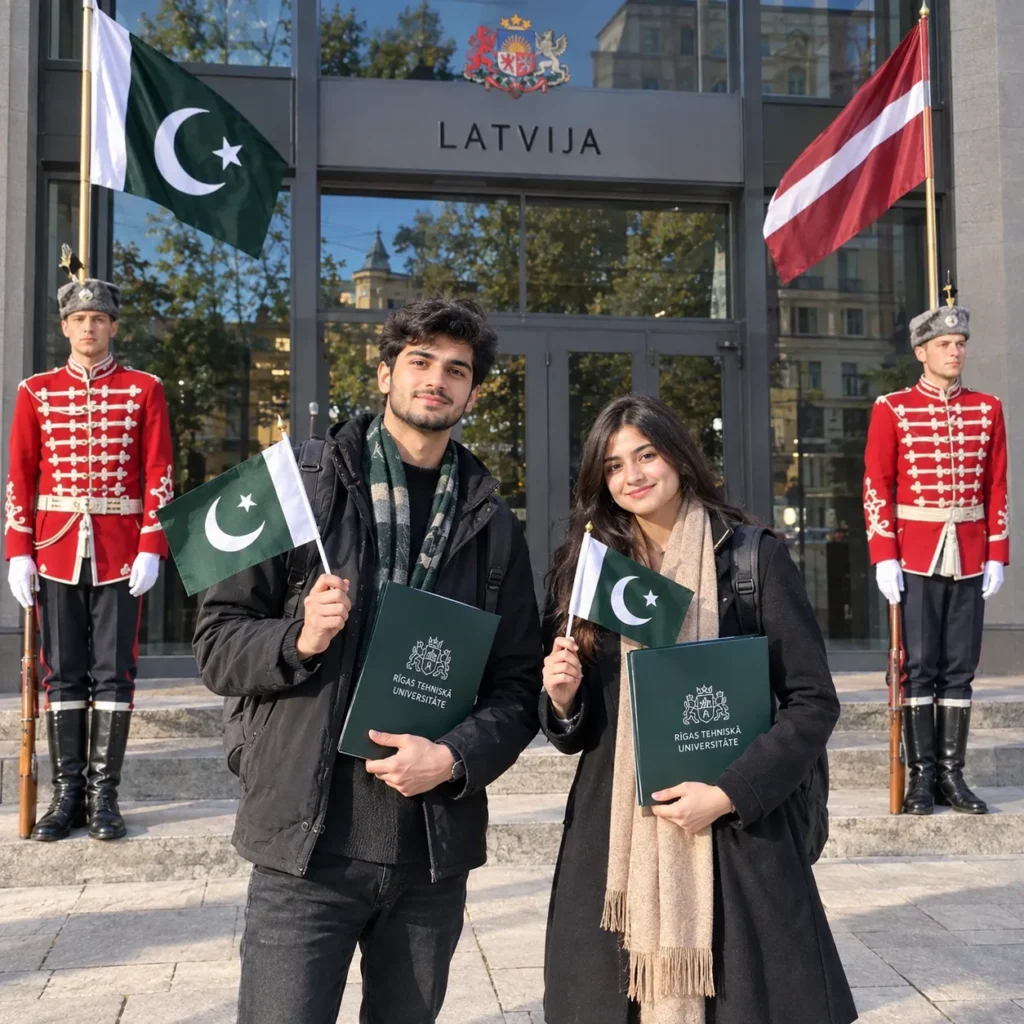
Latvia combines full EU/Schengen membership with genuinely affordable tuition and living costs (living costs reported as roughly 30–51% lower than the US, UK, or Australia) and a notably broad family-reunification definition. 7 Continents Migration Experts guides Pakistani applicants through the category that matches their circumstances.
This page covers three core categories: Type D Visa & Temporary Residence Permit (Main Study Visa), Post-Study Stay-Back Permit, and Family Reunification. Each includes General Eligibility (any nationality) and Eligibility for Pakistani Nationals, plus HEC/IBCC attestation and scholarship guidance.
✓ DISTINCTIVE PROCESS SEQUENCE: unlike most other countries covered on this site, Latvia's process runs residence-permit-decision FIRST, then D-visa SECOND. OCMA reviews and decides on the Temporary Residence Permit application before any visa is issued — the D-visa application form itself can ONLY be completed by applicants who have already received a positive OCMA decision. This is the reverse of the more common 'visa first, then register for residence after arrival' pattern seen in many other European countries.
⚠ FINANCIAL REQUIREMENT VARIES BY SOURCE: sources reviewed cite €6,000/year (one source) versus €10,000/year — approximately INR 8 lakh (a more recent, detailed source). Confirm the current exact figure via OCMA before publishing a single number.
⚠ HEALTH INSURANCE: Latvia sets a specific, official minimum coverage of €42,600 for D visa and residence permit applications — an underinsured policy is a genuine, avoidable rejection risk.
Explore the three categories covered for Pakistani students applying to Latvia — select one to see full eligibility, fees and documents.
Latvia's OCMA-first route for non-EU/EEA students: residence permit decision first, then the D-category entry visa.
A residence extension (6 months per one source) for graduates to search for employment in Latvia.
One of Europe's broadest definitions — spouse, children, parents and siblings of a TRP holder.
Latvia's process for non-EU/EEA students studying more than 90 days — a Temporary Residence Permit (TRP) application reviewed FIRST by OCMA (Office of Citizenship and Migration Affairs), and only once approved can the applicant then apply for the D-category entry visa needed to actually travel to Latvia.
A residence extension allowing graduates to remain in Latvia to search for employment — one source specifically cites a 6-month duration, though this was not corroborated with the same precision across multiple sources reviewed.
A genuinely broad family-accompaniment pathway — once a student holds a valid Temporary Residence Permit, Latvia allows inviting not just a spouse and children, but also PARENTS and SIBLINGS, a notably wider definition of eligible family than many other countries.
🔴 PROCESS SEQUENCE: Latvia's distinctive OCMA-first process is the single most important structural point for this page — clients should understand from the outset that the residence permit DECISION comes before the visa itself, not after, which is the reverse of what many clients may expect from other countries.
FAMILY DEFINITION: The notably broad family-reunification definition (including parents and siblings, not just spouse/children) is a genuine, distinctive advantage worth featuring prominently — it materially differentiates Latvia from several other, more restrictive European study destinations.
HEALTH INSURANCE: The specific €42,600 minimum coverage figure is worth double-checking carefully with clients' insurance providers, since it is considerably more specific than the vaguer "comprehensive coverage" language used for several other countries — an underinsured policy could cause a genuine, avoidable rejection.
Academic transcripts and degree certificates should be HEC/IBCC attested, translated into English, and legalised as required. Confirm the mission serving Pakistani applicants and its exact document requirements.
HEC Attestation
IBCC Attestation
English Translation
AIC Confirmation
Relevant scholarship options for Pakistani students include Latvian government-affiliated scholarships and university-specific tuition support.
Latvian Govt-Affiliated
University Tuition Support
Fulbright
HEC Scholarships
The residence permit decision comes first — OCMA reviews and approves the Temporary Residence Permit, and only then can you apply for the D visa needed to travel.
A notably broad group — parents, siblings, spouse, and children can all be invited once the student holds a valid Temporary Residence Permit, not just spouse and children.
A minimum of €42,600, covering emergency medical care, hospital treatment, and repatriation — confirm your policy meets this specific figure before applying.
Get a free, personalised assessment from our migration experts in Islamabad.